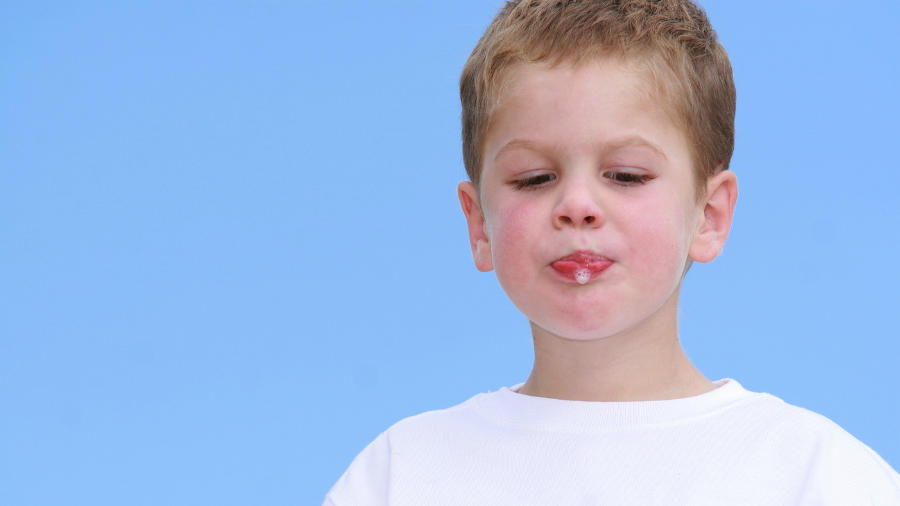
Both purposeful spitting and difficulty managing saliva (drooling) are behaviors that may be seen in some students with disabilities.
What is Purposeful Spitting?
For the purpose of this answer, we will address purposeful spitting. When a child purposely spits on others, it is a learned maladaptive behavior and can be addressed by teaching an appropriate replacement behavior, positive reinforcement of the new behavior, and, if necessary, imposing consequences for the spitting behavior (e.g., loss of privilege, time out, or cleaning an area that has been spit on).
Managing Saliva
When a child cannot manage saliva in their mouth, there is likely a physical or medical reason for this and should be addressed by the appropriate professional, which may include: Pediatrician, Ear Nose & Throat Specialist, Speech Pathologist, or Occupational Therapist.
For the issue of keeping saliva in their mouth, please seek feedback from the student’s speech pathologist, who can conduct an oral motor evaluation; an occupational therapist and/or a referral to a medical professional may be warranted. In some cases, a student may benefit from a visual cue to close their mouth and swallow more often or need some type of bandana or towel to have available to wipe their mouth. It is important to rule out any medical issues before trying a new technique.
Example:
I have a student who can not keep their spit in their mouth, but they will also purposely spit on their peers. Do you have any suggestions?
Managing Saliva and Purposeful Spitting
Both purposeful spitting and difficulty managing saliva (drooling) are behaviors that may be seen in some students with disabilities. It is important to distinguish the two, as one may be related to low muscle tone or other physical issues.
For example, a child may breathe primarily through their mouth due to larger adenoids or tonsils or have oral motor weakness due to other physical problems, which may make it difficult to close their lips and manage their saliva. Purposeful spitting, on the other hand, is behavioral in that the student is using the spitting action to communicate a need or solve a problem in a maladaptive way.
If your student is purposefully spitting on others, it may be an indication of a learned maladaptive behavior or a method the student is using to communicate a need.
- Collect data to help identify what your student is trying to communicate when they choose to spit by using an ABC chart.
- Teach your student appropriate communication skills to replace the spitting behavior. Visual supports and behavior stories can be very helpful in teaching alternative behaviors and communication methods to your student with special needs.
- Use a rewards system so your student is rewarded each time they use a replacement behavior rather than spitting. Acknowledge when the student is practicing appropriate alternative behaviors every time they occur.
- Implement your plan with your students for 4 weeks. If the strategies suggested are not helping, it may be necessary to seek more help and/or get a more in-depth behavioral assessment.
Quick Facts
- Child’s Age: 6-10
- Planning Effort: Moderate
- Difficulty Level: Moderate
Pre-requisites
- Child should understand simple directions, be able to distinguish between right and wrong or “green” or “red” choices, and have the skills to complete the replacement behavior(s) you will teach.
- Child should understand that earning tokens for positive behavior can lead to gaining a preferred item/activity if a token system is to be used.
Strategies to Manage Spitting
- Collect data to determine the possible function of spitting. For example, is it to gain attention or avoid certain activities? A simple ABC Chart (see Resources) can easily be marked after each occurrence of spitting to determine in which instances spitting is more likely to occur and what is maintaining the behavior. For example, if the student spits when he has to give up a preferred item, you may want to teach them to say, “I want it longer.” or “2 more minutes please” as an alternative behavior or to give up the item in response to a visual timer as the preferred behavior. Follow use of appropriate behavior with positive reinforcement (tangible/verbal).
- Teach the student the appropriate social/communication skills that they are lacking so that they do not resort to spitting. For example, you may teach: turn-taking, asking to play, asking for a break, saying no, or waiting.
- Use Social Stories or other visuals (see Resources below) to teach alternatives to spitting and the consequences for both spitting and the use of newly learned skills such as “asking for a break”.
- A tangible reward system, such as a reinforcement tower (also see Resources below) or token system, is a great way to reward appropriate behavior (in this case, using an alternative to spitting).
- If the behavior continues with no change after 4 weeks of intervention, a more thorough functional behavioral assessment may be warranted.
Resources
Oral Motor Activities and Engagement to Reduce Licking (related answer on this site)
Reinforcement tower (PDF)
ABC data sheet (Word document)
ABC data sheet (PDF)
no spitting behavior story (Word document)
no spitting behavior story (PDF)
This resource was authored by Watson Institute Special Education Consultant, Lisa Plastino, M.Ed.
If you have questions or concerns about the Watson Institute’s use of this information, please contact us.