
If a student is disrupting class, try using this strategy as positive reinforcement for when they display appropriate behavior.
What is a Reinforcement Tower?
A reinforcement tower is a unique positive reinforcement system that allows a student to visualize progress towards when a reward will be earned for displaying the target behavior.
Example:
A teacher has a 4th grade student who has “high-functioning autism” and is included in regular education most of their day. The teachers are complaining that the student’s “talk outs” during class are becoming disruptive. The teachers are looking for a positive reinforcement procedure that might work better than the student’s current system, which is a basic star chart that the student doesn’t like.
How a Reinforcement Tower Helps with Disruptive Students
Adaptations can be made to a classic token economy system to make it more exciting and motivating to a student, including customization to appeal to a student’s preferences, “gamification” by making the system more interactive or rewarding, or, for students with the cognitive and verbal ability to do so, collaborating with teachers to create and implement the plan. All of these can provide students a greater sense of investment and agency in their learning!
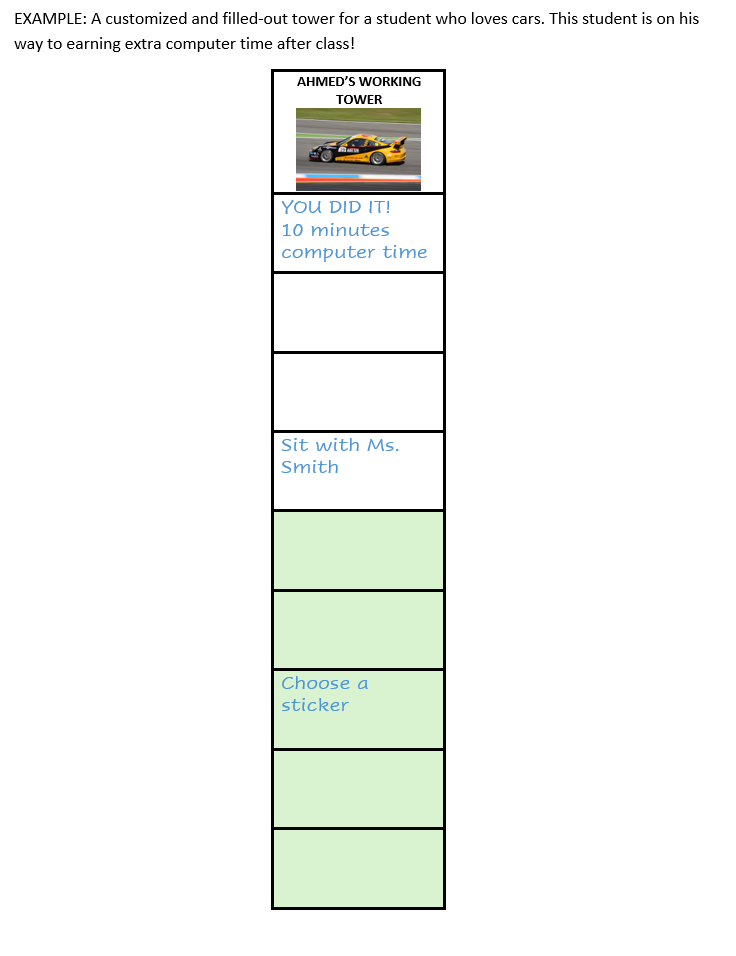
A “reinforcement tower” is one approach to adapting the token economy that can either be “DIY-ed” by a teacher or interventionist or reproduced from a template.
The basic “tower” is divided into several segments or “blocks”. The teacher can decide what the target behavior is and what each block is equal to – this may either be occurrences of a target response like hand-raising or an amount of time that passes without a “call-out” by the student. Then, with the student’s input and preferences in mind, rewards can be listed every few “blocks”, with the most motivating reward at the top of the tower to act as the terminal reinforcer or “end goal” for the student.
When introducing the reinforcement tower or any reward system, begin by ensuring the student is reinforced quickly and often for demonstrating the target behavior (in this case, by marking more rewards with fewer blocks in between). As the student becomes more successful and is displaying the desired behavior more readily, the number of blocks can be increased to gradually fade the amount of reinforcement being delivered.
Quick Facts
- Child’s Age: 6-18+
- Planning Effort: Low
- Difficulty Level: Easy
Pre-requisites
- Menu of reinforcing items (rewards) that a student would like to earn
- “Reinforcement tower” visual
Steps to Using a Reinforcement Tower
- Meet with the student and explain the use of the new reinforcement system. Ask the student to help you generate a “reward menu”. This is a list of 5-10 things that the student would like to be able to earn for demonstrating the desired behavior. These can include access to preferred items or activities, a “pass” or break from a usual task like homework or classroom jobs, or a special privilege or opportunity.
- When choosing rewards, consider how immediately the student needs to be reinforced – would the student benefit more from less frequent but “bigger ticket” rewards, or does the student need smaller rewards more frequently to stay on track? Additionally, consider whether the student can tolerate delayed reinforcement (e.g., a computer break at the end of the day or a “no homework pass” for the evening), or if the reinforcers chosen need to be available immediately after reaching the top of the tower.
- Determine the frequency of reinforcement (how often the student should be able to get a reward) and create the reinforcement tower visual. Consider incorporating a preference, like a favorite color, animal, or character, to personalize the reinforcement tower.
- Determine how you and the student will track behavior on the tower. For example, the teacher can check each block, or shade or color them in, or the student can be taught to mark the chart when the teacher says to do so.
- Prior to each class, remind the student of the plan, how the student can earn blocks and rewards, and what replacement behaviors the student can use instead of talking out (e.g., raising hand, waiting until others are done talking).
- When the student has either completed the desired amount of time with no “call-outs” or has displayed a target response like hand-raising or waiting, you or the student can mark a block on the tower.
- When the student’s chart reaches a block with a reward, the student can either be delivered the reward immediately or reminded that it will be available at its designated time.
- The student can continue to “move up the tower” until the top is reached. If the student does not reach the top, the student has still earned and should receive any rewards that were marked off. If the student reaches the top of the tower, print or copy a new one and start the process over!
- Track the student’s progress using the reinforcement tower charts or another data sheet. As the student improves in self-control and reduces talking out, consider spacing out rewards further apart or increasing the expectation to reach each “block” to fade reinforcement toward more natural levels.
- Make sure to communicate with the student as progress is made, and the plan changes to maintain the student’s buy-in and understanding.
Reinforcement Resources
Reinforcement Tower – Customizable Template (Word document)
The Tough Kid Tool Box by William Jenson, Ginger Rhode, and H Keaton Reavis. This book focuses on practical management and support systems for classrooms, including great reproducible tracking forms, handouts, and charts.)
This resource was authored by Watson Institute Special Education Consultant, Katie Bentz, M.Ed.
If you have questions or concerns about the Watson Institute’s use of this information, please contact us.