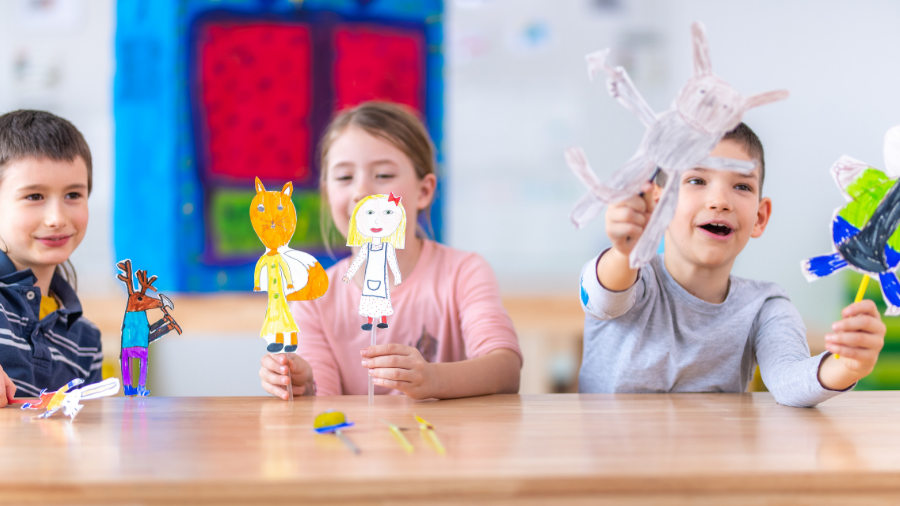
We can help children learn empathy through books and role-play that draw on everyday experiences! Empathy in young children develops best with repeated practice and support from adults.
Young children are naturally curious about the people around them. They notice when a peer is upset, when a teacher is excited, and when a parent seems frustrated. They are beginning to recognize that others have feelings, wants, and experiences that are different from their own.
Empathy is the ability to notice another person’s feelings, perspective, or experiences and respond with care.
Why is Empathy One of the Most Important Skills Children Can Learn?
Empathy is an important skill because it helps young children build the foundation for positive relationships with peers and adults.
Young children are just beginning to notice these things in others, but do not necessarily know what to do about it. As children develop empathy, they are also developing their skills related to:
- Communication: Children learn words and other ways to express feelings, needs, and concerns.
- Problem solving: Understanding another person’s perspective can help children work through conflicts.
- Social connection: Noticing another’s experience can help children form friendships and participate meaningfully in social situations.
- Emotional regulation: Learning to understand the emotions of themselves and others can help children learn to manage their own emotions.
- Perspective taking: Children gradually learn that other people have different feelings and experiences than they do.
Empathy develops over time and can look different at different ages. Some children show empathy with their words, while others show empathy with their actions or simply by staying near. All attempts at showing support and making connections should be acknowledged and praised!
How Can Books and Role-Play Teach Compassion and Kindness?
Books and play give children outlets to explore emotions and express themselves in ways they may not feel comfortable doing otherwise. Using books, games, and role-play to model and teach compassion and kindness helps younger students put abstract emotions into perspectives they can understand.
Use books and stories to spark conversations
Books and stories give children opportunities to explore emotions and different perspectives in a safe and predictable manner. While reading, pause and ask questions to spark thoughts about how characters are thinking and feeling.
Some questions to consider include:
- “Look at this character’s face. I wonder what she might be feeling?”
- “Have you ever felt that way? What happened that made you feel that way?”
- “What would you do to help the child in this story?”
Let the conversations that flow from these questions be the learning opportunity!
Try role-play
Role-play provides children with the chance to practice empathy before actually needing the skill in real life.
Encourage children to act out common scenarios like:
- sharing a toy
- inviting a friend to play
- comforting a friend who is sad
- helping a friend
- taking turns
Add stuffed animals or puppets for extra fun!
Model empathetic behavior
Show empathy in your everyday interactions. If you notice that a child is having difficulty, you could call another child’s attention to the situation and say, “Our friend is having trouble cleaning up by himself. How could we help?”
This simple interaction helps children learn to notice others and think of ways to help. Look for opportunities that occur naturally throughout the day. Children are always watching and learning from us!
It is important that we do not teach children to think that empathy means that they are responsible for always making everyone happy. Instead, teach children how to notice the experience of others and respond with care.
Empathy can look like:
- offering to help
- staying close by when a friend needs us
- getting an adult to help
- inviting someone to play
- taking a turn
- giving a friend space
With repeated opportunities to practice, children will grow their ability to show empathy and feel confident that they can have a positive effect on others!
This resource was authored by Watson Institute Special Education Consultant, Katie Bentz, M.Ed.
If you have any questions or concerns about the Watson Institute’s use of this information, please contact us.