When it comes to careers in the field of special education, there are two job titles that are often confused: Behavior Technicians (BT) and Behavioral Health Technicians (BHT).
While they might sound similar, these roles, their responsibilities, skills, and certifications can be quite different. We’re going to break down how they are different and what sets them apart so you can understand which path might be right for you if you’re pursuing a career in special education.
In what settings are BTs most commonly employed versus BHTs?
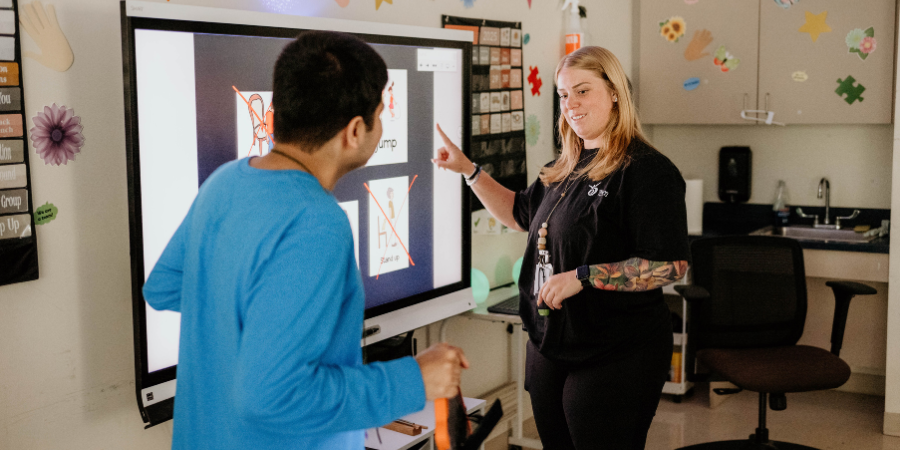
A Behavior Technician (BT) works in special education classrooms alongside the special education teacher and instructional aides. As part of the educational team, BTs work with physical, occupational, speech, and vision therapists as well as specials teachers (art, adapted physical education, and music) to provide daily support for students with disabilities.
BTs monitor the behavioral patterns of students, collecting and analyzing data trends to help guide strategies and interventions they try in the classroom.
Behavioral Health Technicians (BHT) work in the Intensive Behavioral Health Services (IBHS) program which is community-based. This program was formerly referred to as wraparound services.
BHTs meet with individuals in their home, school, or community settings to provide therapeutic support and interventions to help children participate in daily activities and routines.
At a basic level, both of these roles are focused on supporting children with disabilities, providing behavioral management strategies and tools. However, the programs and settings in which they operate are very different and shape each role in unique ways.
Is a behavioral health technician (BHT) the same as a registered behavior technician (RBT)?
A Behavioral Health Technician is not the same as a Registered Behavior Technician; however, an RBT is an appropriate qualification to work as a BHT.
A Registered Behavior Technician is an instructional aide (paraprofessional) that has achieved a particular level of education and training in the field of special education. An RBT has earned a certification through the Behavior Analyst Certification Board (BACB) and works under the supervision of a Board-Certified Behavior Analyst (BCBA) or a supervisor of similar qualification.
What are the job requirements of a behavior technician vs. a behavioral health technician?
Behavior Technicians have attained a bachelor’s degree in education, psychology, or a related field and have completed a 40-hour online Certification Program within one month of starting their employment. The Certification Program is the same course RBTs take, but without the additional supervision and in-person training requirements.
Advancing from a paraprofessional position or another entry-level role to a Behavior Technician job at Watson is supported through our tuition reimbursement program and has helped many employees take the next steps in their educational and career journeys.
Behavioral Health Technicians are not required to have an advanced degree (a high school diploma or GED will suffice), but they must have obtained a certification from an accredited institution (such as a: BCaBA, RBT, or BCAT), or have a minimum of 2 years of experience providing behavioral health services.
Despite these positions having different requirements, working in different settings, and a number of other small things that set them apart, the commonality between a Behavior Technician and a Behavioral Health Technician is that both aim to support students with disabilities through behavior management.
Learn more about these and other job opportunities at the Watson Institute and join our team!
Editor’s Note: Descriptions of the job responsibilities and requirements for Behavior Technicians and Behavioral Health Technicians outlined in this article are applicable to the Watson Institute’s schools and special education programs and may not be universal to all organizations and settings.
Editor’s Note 2: We used a number of initials in this article (every professional field has its own acronyms!). In case you need it, we’ve included this quick reference guide.
Quick Reference Guide:
BT – Behavior Technician
BHT – Behavioral Health Technician
RBT – Registered Behavior Technician
Instructional Aide – also called a Paraprofessional
BACB – Behavior Analyst Certification Board
BCBA – Board-Certified Behavior Analyst