How to Teach Social Safety Awareness
Utilizing social stories in addition to concrete visuals are strategies that can be used to teach children about safety in regard to personal space, friends, and strangers.
Example:
How do you teach a child about not talking to strangers? My 11-year-old child will open the door for anyone and also will just go up to people at restaurants/malls or various events and talk to them. They will introduce them to me as her friends. I have tried to verbally explain to my child not to just go up to anyone unless I am there, but this has not worked.
Using Social Stories and Visuals
Teaching children with learning disabilities about safety and the rules of friendship can be quite challenging. Using social stories and visuals can help your child to understand and follow the often confusing social rules. Utilizing these strategies provides concrete visual examples and a variety of ways to understand the complex rules and reasons regarding safety, talking to strangers, and personal space.
For example, children need to be specifically taught with multiple opportunities to practice such skills as identifying friends / non-friends and who it is okay to hug and who it is not okay to hug. Additionally, children need to be taught about “good touch/bad touch” and what to do if someone breaks these rules.
There are also programs, sometimes used by schools and community agencies, which specifically address the social / sexual concepts of personal space, social distance, and relationships by providing step-by-step instruction for students who are challenged in these areas. One such program is Circles Program I: Intimacy and Relationships by Champagne & Walker-Hirsch.
Ensure that you discuss these guidelines of social relationships with your child often, especially as you are preparing to go out into a public place such as a restaurant or shopping mall.
Quick Facts
- Child’s Age: 11-17
- Planning Effort: Low
- Difficulty Level: Easy
Pre-requisites
- the ability to follow simple directions
- the ability to respond to questions and instructions
Process for Social Awareness and Safety
- Using social stories such as the ones listed in Resources below, talk with your child and help them identify who the people in their life would be considered appropriate to hug.
- Use pictures of friends, family, and strangers and teach your child to identify which people would be appropriate to talk to or hug. This can be done as a sorting activity or through conversations using visual supports.
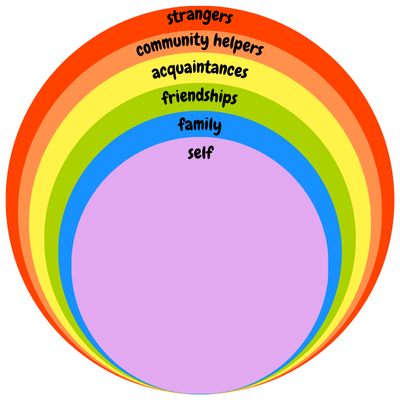
- Set aside time on a regular and ongoing basis to teach about Social Circles. This is another visual strategy that shows children degrees of proximity/intimacy within social relationships and how to interact in an acceptable manner.
- Start by making a small circle in one color on a large piece of paper with your child’s name or photo inside the circle. Explain that this is your child’s personal space.
- Draw a larger circle in a different color around the child’s circle and write “Family”. You can use photos or names in the circle. Explain that these people are “Family,” and your child may kiss or hug them.
- Draw a larger circle in a different color around the “Family” circle. This circle is “Friends and Neighbors”. Write the names or use photos to show these people. Explain that these are people you might wave to or say hello to.
- The last circle in a different color again is labeled “Strangers” or “People You Don’t Know”. Provide examples of strangers (people in stores, restaurants, playgrounds, etc.) Explain that it is not okay to hug, kiss, open the door, get too close, or touch strangers.
- As your child’s understanding of these concepts grows, you might want to teach them about exceptions to the rules (police people, firefighters, doctors, nurses, etc.)
- The Circle strategy can also be used to teach about appropriate touching and not touching.
- When going out with your child, before entering the restaurant or mall, review the rules of who it is appropriate to talk to or hug.
Resources for Social Safety Awareness
Circles Intimacy and Relationships Program (link to retail site)
All About Hugging and Touching (word document – social story)
All About Hugging and Touching (powerpoint)
I like to Hug (Word document – socialstory)
Social Stories about Touch – related resource with social stories about appropriate touch
Sexual Education for Children with Disabilities – a blog series presented by Watson’s Special Education Consultant, Dr. Rachel Schwartz
This resource was authored by Watson Institute Special Education Consultant, Rachel Schwartz, Ph.D., BCBA-D
If you have questions or concerns about the Watson Institute’s use of this information, please contact us.