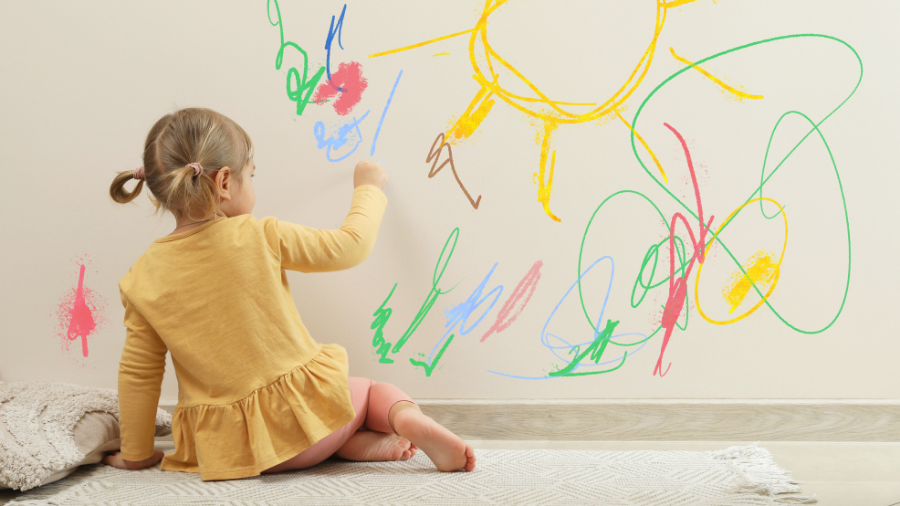
Are you having problems with your child drawing on walls? Try using a social story and visual supports explaining replacement behavior.
What is a Replacement Behavior?
This strategy teaches a different behavior that replaces drawing on the walls. It uses a social story to explain the new behavior from the student’s perspective and visual supports to remind the child about the rule. Interruption and redirection is a behavioral method used to prevent attention from being given to a negative behavior and providing attention to positive replacement behaviors instead.
Example:
My 7-year-old son, diagnosed with autism, is constantly writing or scratching on my walls with anything he can find, whether it’s a pen to write or one of his toys to scratch. He draws mostly bridges on my walls, but he does draw other things as well (things that interest him). I was thinking about painting a wall with dry-erase paint and making it clear that it’s his wall to draw on to try to contain the drawing to one area. My questions are: Could my idea work, and if not, how do I get him to stop drawing on my walls?
Replacement Behavior Strategy
Encourage drawing but with a replacement surface for their artwork instead of the walls in your home.
- Create or buy a dry erase board with compatible markers and keep it in a spot where your child / student often draws or plays in your home or in school. You may also like to make a bin with drawing / writing tools and paper.
- Prepare a simple social story about writing on a dry erase board or paper instead of the wall and read this story with your child / student every day (even a few times per day). The social story should be told from your child / student’s perspective to make it relatable to them.
- Create note cards that say “No drawing on walls – draw on your board” and tape them up on the walls in the rooms where they like to draw.
- Show your child / student the dry erase board and encourage them to draw on it. Praise them when they are using the dry erase board to reinforce that this is a positive behavior.
- Show your child / student the special bin of paper and drawing tools you made and where it will be when they want to draw. Praise them when they use the drawing bin instead of coloring on the walls.
- Try to interrupt your child / student and redirect them to the dry erase board if you catch them making a move to draw on the walls. If they do draw on the wall, hand the child the note card that says “no drawing on the walls – draw on your board” and show them over to the dry erase board without any other talking. Once they begin to draw on the dry erase board, give them positive attention and reinforcement for drawing in the correct place.
Remember to enthusiastically praise and reward them when they use the board and paper to draw. It is important that the praise they get when they draw on the whiteboard or paper is very specific so that they know exactly what they did “right”.
For example, instead of “nice job!” say “I love your picture on the paper!” along with a high five. This differentially reinforces them for drawing on appropriate surfaces.
When you are first teaching them to stop drawing on the walls, it will take some effort and time. As your child receives your positive attention and rewards for drawing on the board and/or paper, they will be more likely to repeat that behavior, which of course is what you want!
Quick Facts
- Child’s Age: 3-10
- Planning Effort: Low
- Difficulty Level: Easy
Suggested Pre-requisites
- A dry erase board or a piece of plywood and dry erase paint
- A bin filled with writing and drawing tools, paper
- Several pictures that have been drawn on paper, not walls
- A simple social story about where to draw rather than drawing on walls
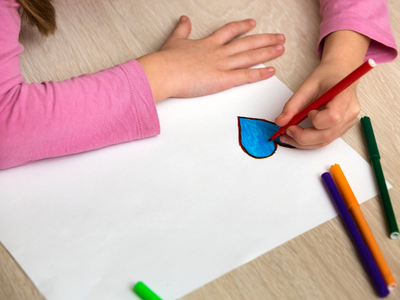
Steps to Creating this Replacement Behavior Strategy
- Make or buy a dry erase board and hang it in a spot where your child often draws or plays in your house. Buy special markers to go with the board.
- Make a bin with drawing / writing tools and paper.
- Write a simple social story (see sample in Resources) about writing on a dry-erase board or paper instead of the wall.
- Make cards (see sample in Resources) that show “No drawing on walls – Draw on the board” and tape them on the walls in the rooms where your child likes to draw.
- Read the social story a couple of times each day until your child can follow the rule of not drawing on the walls.
- Show your child the dry erase board. Let them draw on it and praise them.
- Show your child the drawing bin you made for them and where it will be when they want to draw.
- Try your best to watch your child closely the first few days and “catch” them before they draw on the walls. Use interruption and redirection and have them draw on the board.
- If they draw on the wall, hand them the visual support, tell them, “no drawing on the wall, go to the board”. Help them to the board without any other talking. Once they begin to draw on the board, give them positive attention for drawing in the right place. Strongly reinforce using the replacement behavior.
- As time progresses and they are able to be more independent, you will be able to fade back your support. However, remember to still provide them with positive reinforcement when they use the board.
Replacement Behavior Resources
Social Story I like to draw, word doc
Social Story I like to draw, pdf
Visual support No drawing on Walls, Draw on board, word doc.
Visual Support No drawing on Walls, Draw on board, pdf
This resource was authored by Watson Institute Special Education Consultant, Lisa Plastino, M.Ed.
If you have questions or concerns about the Watson Institute’s use of this information, please contact us.