
Using a voice meter as a visual support can help children understand appropriate levels of voice volume in community settings.
What is a Voice Volume Level Meter?
A Voice Volume Level Meter is a visual support that will assist children whose speaking voices are very loud or very quiet to adjust the volume of their voices to appropriate levels in a variety of community settings.
Example:
How may I help my child learn to keep the volume of their speech at the appropriate level of loudness when we are in different community settings?
Using a Visual Support Voice Volume Meter
A voice volume meter visual support can be easily made with minimal materials.
Materials needed include: paper or oak tag, colored markers, pencils or crayons, and protective covering for the meter, such as contact paper, clear packaging tape, laminate, or a sheet protector.
One example of a voice meter is a rectangular strip of paper with the numbers 1-5 aligned vertically in squares on the paper. Numbers are placed in squares with 1 on the bottom and 5 on the top.
Each number square is colored in graded shades of blue, with 1 being the lightest color and 5 the darkest shade.
Each number represents a volume level:
5 = yelling or screaming
4 = loud talking
3 = normal conversational volume
2 = whisper
1= silence
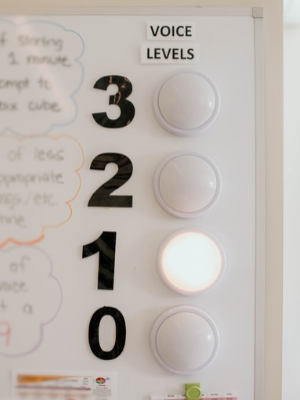
We provide a Sample Voice Level Meter visual support in the Resources section below.
Quick Facts
- Child’s Age: 3-18+
- Planning Effort: Low
- Difficulty Level: Easy
Pre-requisites
- Commercial or handmade voice volume meter
Process for Teaching Children Voice Volume Levels
- The voice volume meter should be introduced to the child prior to using it.
- Explain the meter and model the volume each number represents.
- Have the child look at the voice volume meter, hold it, and practice making their voice louder or quieter according to each number/color level.
- Give the child voice models for each number and have them imitate.
- Role-play different situations and model / practice the appropriate loudness and corresponding number/color shade.
- After the child has experienced using the meter in practice situations, take the voice volume meter into community settings. Show the child the level of loudness for each setting on the meter.
- Praise and/or reward the child for using the appropriate volume.
- If the child’s voice is too quiet or too loud, you may tell and show them the number they are using and tell / show them the appropriate volume level on the voice meter.
Resources
Sample Voice Volume Level Meter (PDF)
Talking Voice Story (Word Document)
Talking Voice Story (PDF)
SET-BC Resources (website resource for pictures/icons)
This resource was authored by Watson Institute Special Education Consultant, Lisa Plastino, M.Ed.
If you have questions or concerns about the Watson Institute’s use of this information, please contact us.